

Vendai
Lead Product Designer
Vendai is a real-time, location-based platform designed to help people discover nearby street vendors while increasing visibility for vendors within their communities.
Street vendors play a vital role in many neighborhoods, but their mobile nature makes them difficult to find. Customers often rely on word of mouth or chance encounters, creating a disconnect between supply and demand.
As the sole designer, I led the end-to-end design of this product, focusing on creating a fast, intuitive experience that supports real-time discovery while balancing the needs of a two-sided marketplace.


Context
📋 Overview
Growing up in Los Angeles near the Port, I was surrounded by a community built by immigrants, including my own family. Street vendors were a constant presence, serving food and creating moments of connection across neighborhoods.
But they were also difficult to find.
Vendors moved frequently, had no consistent digital presence, and relied heavily on foot traffic or word of mouth. Discovering them often meant physically searching, with no reliable way to find or return to them in real time. This gap results in missed opportunities on both sides, where vendors lose visibility and customers miss nearby options in real time.
This revealed a clear gap, there was no system connecting nearby customers to street vendors when it mattered most.
Vendai explores how a mobile, location-based experience can make vendor discovery instant, reliable, and accessible.
Problem
⚡ The Challenge
How might we help people discover nearby street vendors in real time while enabling vendors to be more visible within their communities?
Customers often rely on word of mouth or chance encounters to find street vendors, because vendors frequently move locations throughout the day, there is no reliable or consistent way to locate them when needed.
For vendors, this lack of visibility limits their ability to reach new customers and maintain a steady flow of demand. For customers, it creates frustration and missed opportunities to engage with local businesses.
Existing solutions do not account for the dynamic, real-time nature of street vending, leaving a clear gap between vendors and the people trying to find them.
🧭 Understanding the Experience
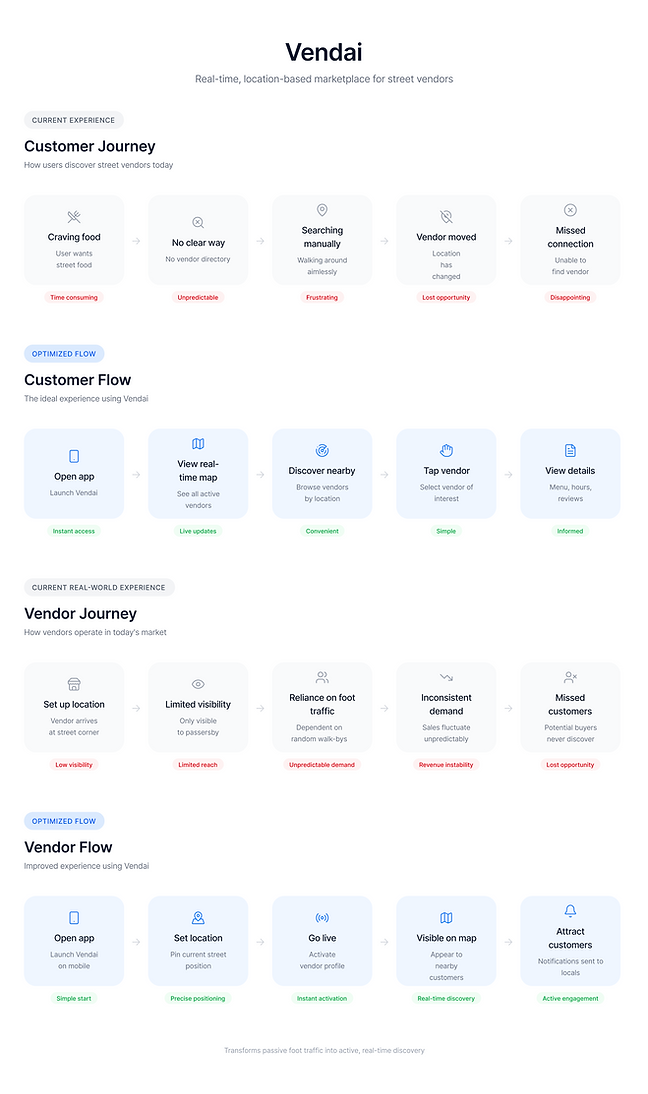
Vendai operates as a two-sided marketplace, requiring consideration of both customer and vendor journeys. Understanding how each side interacts with the system revealed distinct friction points.
Key Insights
Discovery is driven by proximity, not search
Users are not actively searching for vendors, they are reacting to what is nearby, making location visibility more critical than traditional browsing.
Speed outweighs exploration
Customers make quick, on-the-go decisions, prioritizing immediate, relevant options over deep exploration or comparison.
Vendors rely on passive visibility
Vendors depend heavily on foot traffic, limiting their ability to reach users beyond their immediate surroundings.
Real-time variability breaks trust
Frequent location changes create uncertainty, making it difficult for users to rely on static or outdated information.
Supply and demand are disconnected
There is no system that connects users actively looking for vendors with vendors available in real time.
Key Decisions
Prioritized a map-first experience
Aligned the interface with how users navigate physical space, reducing the gap between discovery and action.
Designed lightweight vendor cards
Focused on quick scanning over deep browsing to support fast, in-motion decisions.
Reduced reliance on filters early on
Avoided friction that could lead to empty or dead-end experiences.
Focused on real-time interaction over planning
Optimized for immediate decisions rather than future intent.
Balanced simplicity with scalability
Ensured the experience works in both low-density and high-density environments.


Constraints
The product needed to function in a real-time, location-based environment with both customer and vendor needs, introducing several technical and experience constraints that directly shaped the design decisions.
Real-Time Location Accuracy
Vendor locations are dynamic and may not always update instantly or accurately, requiring the experience to communicate proximity and availability without relying on perfect real-time precision.
Dual-sided user complexity
The platform must support two distinct user groups, customers seeking nearby vendors and vendors managing their presence, requiring separate but cohesive flows without increasing overall system complexity.
Time-sensitive user behavior
Customers often make quick, on-the-go decisions, requiring the interface to prioritize immediate access to relevant information with minimal interaction.
Inconsistent vendor-provided data
Vendor inputs such as location, availability, and offerings may be incomplete or outdated, requiring the system to remain functional and trustworthy despite gaps in data.
Mobile-first usage constraints
The experience is designed for mobile environments, requiring efficient use of limited screen space and interactions optimized for speed and ease of use.
Discoverability vs. simplicity trade-off
Balancing visibility of nearby vendors with a clean, uncluttered interface required prioritizing essential information while avoiding cognitive overload.
Solution
🧠 Intro
To address the unpredictability of street vendor discovery, I designed a map-first experience that enables users to locate and interact with nearby vendors in real time. The goal was to create a seamless connection between customers and vendors, reducing the need for manual searching and guesswork.
The solution focuses on providing immediate visibility into vendor locations while supporting quick, intuitive interactions that move users from discovery to action with minimal friction.
Design
Customer Experience
Users open the app and immediately see nearby vendors through a map-based interface.
Vendor cards provide just enough information to support quick decisions, allowing users to move from discovery to action with minimal friction.
The experience prioritizes speed, clarity, and immediacy.

Design
Vendor Experience
Vendors are given a way to actively participate in the marketplace by surfacing their presence to nearby users in real time.
The experience focuses on increasing visibility and reducing reliance on passive foot traffic, allowing vendors to be discovered in the moments that matter most.

Edge Cases
Designing for real-world conditions was critical to maintaining a reliable experience.
-
No vendors nearby
-
Inaccurate or outdated location data
-
Poor signal or connectivity
-
Vendors appearing and disappearing throughout the day
Impact
🚀 Results
-
Reduced reliance on physical searching by enabling instant, location-based discovery
-
Shortened the path from discovery to action to a matter of seconds
-
Increased vendor visibility in high-traffic environments
-
Established a foundation for a scalable, real-time marketplace system
Reflection
Designing Vendai reinforced the importance of building for real-world behavior, not ideal conditions. Street vendors operate in constantly changing environments, where location, availability, and demand are inherently unpredictable.
This required shifting away from precision-driven design toward systems that remain useful even with imperfect or delayed data.
Working through a two-sided marketplace also highlighted the challenge of balancing customer discovery with vendor visibility. Improving one side without addressing the other would create an imbalanced experience, limiting the effectiveness of the system as a whole.
One of the key takeaways was recognizing that early-stage marketplace success depends less on feature depth and more on achieving a critical level of supply. Without enough active vendors, even a well-designed experience risks breaking down.
If I were to continue this work, I would focus on validating vendor adoption and exploring mechanisms to increase participation, such as onboarding incentives or visibility controls. I would also look into ways to communicate data confidence more clearly, helping users make informed decisions even when real-time accuracy is not guaranteed.